27 KiB
| bibliography | link-citations | mainfont | monofont | sansfont | title | title-block | |
|---|---|---|---|---|---|---|---|
|
true | Linux Libertine O | DejaVu Sans Mono | Linux Biolinum O | Clear Skies - A Reference Architecture for Resilient Alaskan Microgrid Cyberinfrastructure | false |
Basic Book Builder
A Pandoc Template for building books and articles

| Title | Basic Book Builder |
| Subtitle | A Pandoc Template for building books and articles |
| Affiliation | Alaska Center for Energy and Power |
| Institution | University of Alaska Fairbanks |
| Author | John Haverlack |
| Copyright | © 2025 Alaska Center for Energy and Power |
| License | CC BY-ND 4.0 |
| Version | 0.0.2 |
| Date | 2025-11-11 |
| State | PRE-RELEASE |
| Source | https://github.com/jehaverlack/basic-book-builder |
Introduction
This is a basic book (or article) builder template based on a Pandoc build process in conjunction with a number of other tools to generate PDF, ODT, HTML, LaTex, Markdown, and Epub book output formats from Markdown source content , which can optionally be edited as an Obsidian vault.
This book builder template has been curated by John Haverlack.(“John Haverlack ACEP” n.d.)
Conventions
A few callout box styles have been added to easily highlight content.
Established Concept
Einsteins Relativistic Dynamics Equations E2 = (m0⋅c2)2 + (p⋅c)2
Proposed Concept
With the speed of light, c = 1: E2 = m02 + p2
Speculative Concept
With the speed of light, c = 1: E2 = m02 + p2
Caution Note
Beware of this section.
Warning Note
Beware of this section.
Alerts
Extreme Highlight
Getting Started
Installing Pre-Requisites
For Debian / ZorinOS and likely Ubuntu based systems.
TODO
It would be nice to roll a setup script to take care of this.
Required
Pandoc
sudo apt install https://github.com/jgm/pandoc/releases/download/3.8.2.1/pandoc-3.8.2.1-1-amd64.deb
Code Editor
Code Editor
VSCodium is recommend for privacy (telemetry/tracking) reasons - https://vscodium.com/
But any text editor will work. #### make
sudo apt install make
jq and yq
sudo apt install jq yq
texlive
sudo apt install texlive texlive-xetex texlive-latex-extra texlive-fonts-recommended texlive-fonts-extra
MathJax
wget https://registry.npmjs.org/mathjax/-/mathjax-3.2.2.tgz
tar xzf mathjax-3.2.2.tgz
mv package/es5/* lib/mathjax
rm -rf package mathjax-3.2.2.tgz
TODO
This need to be rolled into a setup script.
Optional
The following are not strictly requires to use this book builder template.
Obsidian
Highly Recommended
Editing book chapter content in Obsidian is a very productive means for editing Markdown source content.
sudo apt install https://github.com/obsidianmd/obsidian-releases/releases/download/v1.9.14/obsidian_1.9.14_amd64.deb
Zotero
Highly Recommended
If you need to managed citations and references, Zotero integration is highly recommended.
sudo cp ./scripts/deps/zotero.list /etc/apt/sources.list.d/

sudo apt update

sudo apt install zotero
Better BibTex for Zotero
Install the Better BibTex Plugin for Zotero - Zotero > Tool > Plugins
Export citations.bib
- Zotero > File > Export Library > Format: Better BibTeX
- Keep Updated
- Save to: ~/Documents/Lib/zotero.bib
- Symlink your ~/Documents/Lib/Citations.bib to basic-book-builder/lib/zotero.bib
Zotero Connector Browser Plugin
Provides you the ability to auto add Web resources to your Zotero citation database.
lmodern
sudo apt install lmodern
epubcheck
sudo apt install epubcheck
foliate
An EPub Reader
sudo apt install https://github.com/johnfactotum/foliate/releases/download/2.6.4/com.github.johnfactotum.foliate_2.6.4_all.deb
calibre
An EPub Reader
sudo apt install calibre
Editing the Configuration
Editing the Book
Configuration
There are a number of other config files for each format:
conf/
├── epub-metadata.xml
├── epub_template.html
├── epub.yaml
├── frontmatter_epub.md
├── frontmatter_epub.xhtml
├── frontmatter.html
├── frontmatter.tex
├── header.tex
├── html.yaml
├── latex.yaml
├── markdown.yaml
├── metadata.yaml
├── pandoc.yaml
├── pdf.yaml
├── style.css
└── style_epub.css
Main Config Files
- metadata.yaml - Set Title, etc
- pandoc.yaml - Main Pandoc Config #### Per format Configs
pdf.yamlhtml.yamllatex.yamlepub.yaml
FrontMatter Config
There are 2 Version of the FrontMatter for PDF, and HTML bases formats that set the Title, Author, Verizon, Copyright, etc…
frontmatter.texfrontmatter.htmlfrontmatter_epub.*- Work in Progress
There is probably a better way to do this.
Editing the Content
To edit the book open the basic-book-builder directory as an Obsidian
Vault.
- Edit the Markdown content in the
chaptersdirectory.
Citations
Note: the Zotero database needs configured to export automatically to
lib/citations.bib
To insert a Zotero Citation - Ensure the Zotero App and DB are running on you system. - Alt + I (to insert citation) - Search for and select citation reference
Usage: Building the Book
make pdf
HTML
make html
LaTex
make latex
Markdown
make markdown
EPub
Note: This ePub configuration still needs tuning.
make epub
Example Content
In R**ν the Planck Length is the universal unit for measurement of distance, and is defined approximately to be:
\\boxed{L_P=\\sqrt{\\hbar}=5.72928\\times10^{-35}m=1 L}Where 1 L, is 1 Planck Length of distance.
SI Conversion Factors
The following conversion factors can be used to convert observable quantities of measure from the SI system of units to R**ν to ~6 significant digits.
| Conversion Factor | Symbol | Value |
|---|---|---|
| meters to Planck Length | χP | 1.74542\\times10^{34} \\frac{L}{m} |
| seconds to Planck Length | τp | 5.23264\\times10^{42} \\frac{L}{s} |
| mass to Planck Length | GP | 1.62871\\times10^8 \\frac{L}{kg} |
| energy to Planck Length | EP | 1.81219\\times10^9 \\frac{L}{J} |
| momentum to Planck Length | PP | 5.43280\\times10^{-1} \\frac{L\\cdot s}{kg \\cdot m} |
| temperature to Planck Length | kP | 2.501998\\times10^{-14} \\frac{L}{K} |
| charge to Planck Length | CP | 1.89007\\times10^{18} \\frac{L}{C} |
Physical Constants
Applying conversion factors from the table above, we can convert SI values to Reduced Natural Units. For example, performing this analysis on the the speed of light yields a unit-less number with a value of 1:
c = 299792458 \\frac{m}{s} = 299792458 \\frac{m}{s} \\cdot 1.74542\\times10^{34} \\frac{L}{m} \\cdot \\frac{1}{5.23264\\times10^{42} \\frac{L}{s}} = 1.00000
| Quantity | Symbol | SI | ν |
|---|---|---|---|
| Speed of Light | c | 299792458 \\frac{m}{s} |
1 |
| Reduced Gravitational Constant | G0 | 8.38659\\times10^{-10} \\frac{m^3}{kg \\cdot s^2} |
1 |
| Boltzmann’s Constant | k | k=1.380649\\times10^-23 \\frac{J}{K} |
1 |
| Permittivity of Free Space | ϵo | 8.854187817620\\times10^{-12} \\frac{C^{2}s^2}{kg \\cdot m^3} |
1 |
| Permeability of Free Space | μo | \\huge{\\frac{1}{\\epsilon\_{o} \\cdot c^{2}}} |
1 |
| Reduced Planck’s Constant | ℏ | 1.054571726\\times10^-34 \\frac{kg \\cdot m^2}{s} |
1L2 |
| Mass of the Electron | me | 9.10938 × 10⁻³¹k**g | 1.48366 × 10⁻²²L |
| Charge of the Electron | e− | − 1.60218 × 10⁻¹⁹C | − 3.02822 × 10⁻¹L |
| Unit Cycle | Θ | 2π = 6.28318... Radians | 1τ = 6.28318... Radians |
Fine Structure Constant
As a consistency check, we compute the Fine Structure Constant using Reduced Natural Units which is a unit less ratio that should be independent of our system of units.
\\huge{\\alpha=\\frac{e^2}{4\\pi\\epsilon_o\\hbar c}=\\frac{e^2}{2\\tau}=0.00729735≈\\frac{1}{137}}
Dimensional Analysis
The reader should be familiar with high school physics and chemistry dimensional analysis.
- 1 meter (m) = 100 centimeters (c**m)
- 1 kilometer (k**m) = 1000 meter**s (m)
- 1 mil**e = 5280 fee**t (f**t o**r ′)
1\\ foot\\ (ft\\ or\\ ') = 12\\ inches\\ (in\\ or\\ ")1\\ inch\\ (") = 2.54\\ centimeters\\ (cm)
How many kilometers are in 1 mile?
1\\ mile = 1\\ mile \\times \\frac{5280\\ ft}{mile} \\times \\frac{12\\ in}{ft} \\times \\frac{2.54\\ cm}{in}\\times \\frac{1\\ m}{100 cm} \\times \\frac{1\\ km}{1000 m} = \\frac{5280 \\times 12 \\times 2.54}{100 \\times 1000}\\ km = \\frac{160934.40}{100000}\\ km = 1.6\\ km
Note that each unit in the denominator cancels with one if the numerator
until we are left with only km.
Newton’s Law of Gravity
The force of gravity (Fg) between 2 masses, m1 and m2 separated by distance r is given by Newton’s Law of Gravity:
F\_{g} = G \\frac{m\_{1} m\_{2}}{r^{2}}
Where G, is the Gravitational Constant.
G = 6.67430 \\times 10^{-11}\\ N\\frac{m^2}{kg^2}
The strength of gravitational force follow the inverse square law distributing gravitational flux over the surface area of a sphere (4π**r2).
Inverse Square Law
Any source of a signal strength (S0) that radiates isotropically in 3-dimensional space will distribute that signal strength (S0) over the surface area of a sphere (S**A = 4π**r) of radius (r). Such that the intensity (I) at distance (r) is:
I(r) = \\frac{S_0}{4 \\pi r^{2}}=\\frac{S_0}{2 \\tau r^{2}}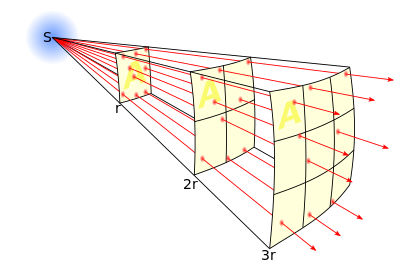 #### R**ν
Reduced Gravitational Constant In this version of Newton’s Law of
Gravity we introduce a new constant G0, the reduced
gravitational constant to accommodate for the factor of 4π = 2τ
which is has been integrated in the SI version of the gravitational
constant.
#### R**ν
Reduced Gravitational Constant In this version of Newton’s Law of
Gravity we introduce a new constant G0, the reduced
gravitational constant to accommodate for the factor of 4π = 2τ
which is has been integrated in the SI version of the gravitational
constant.
F_g =G \\frac{m\_{1} m\_{2}}{r^{2}}= G_0 \\frac{m\_{1} m\_{2}}{4 \\pi r^{2}}=G_0 \\frac{m\_{1} m\_{2}}{2 \\tau r^{2}}
Where:
G = \\frac{G\_{0}}{2\\tau} = 6.67384 \\times 10^{-11} \\frac{N \\cdot m^2}{kg^2}
Analyzing the units:
\\frac{N \\cdot m^2}{kg^2} = \\left( \\frac{\\left( kg \\cdot \\frac{m}{s^2} \\right) \\cdot m^2}{kg^2} \\right)=\\frac{m^3}{s^2 kg}Converting seconds to meters with the SI speed of light as a conversion factor:
\\frac{m^3}{s^2 kg}\\cdot\\frac{1}{c^2}=\\frac{m^3}{s^2 kg}\\cdot\\frac{s^2}{m^2}=\\frac{m}{kg}Thus where space and time are measured in units of meters, the reduced gravitational constant, is:
\\boxed{G_0=\\frac{2\\tau G}{c^2}=\\frac{2\\tau \\cdot 6.67384 \\times 10^{-11}}{299792458^2} \\frac{m}{kg} = 9.33135 \\times 10^-27 \\frac{m}{kg}}Observation This implies that not only can space an time be measure in units of meters, but so can mass.
Relativistic Energy Momentum Relation
Einsteins Relativistic Energy Momentum relationship shows a Pythagorean relation between the total energy (E), rest mass (m0) and momentum (p) of a system.
E2 = (m0⋅c2)2 + (p⋅c)2
Where space and time are both measure in units of meters, c=1.
E2 = (m0)2 + (p)2
From this we can see that Energy, Momentum and Mass have equivalent units.
While we do not really know what energy, mass and momentum are we know that they are fundamentally “made” out of the same stuff because they have the same units.
Objects of mass at rest
For an object at rest with no momentum (p = 0) we see Einstein’s famous equations:
E = m0 ⋅ c2
Or, with c = 1, this is much simpler to understand. Energy = Mass
E = m0
Zero mass objects moving at the speed of light
And for objects with no mass, like photos, (m0 = 0):
E = p**c
Or, with c = 1, this is much simpler to understand. Energy = Momentum
E = p
Planck’s Constant
The Reduced Planck constant , ħ, represents a conversion factor for relating the frequency, ω (in 2π radians per second), of a photon to the energy of that photon. This can easily be seen from the simple but profound relationship:
E = ℏω
Where:
ℏ = 1.054571726 × 10⁻³⁴J ⋅ s
and
J \\cdot s = {kg}\\cdot\\frac{m^2}{s}
Reduced Planck’s Constant
\\hbar = \\frac{h}{2\\pi} = \\frac{h}{\\tau}
Simplifying our units by converting time and mass to units of meters:
\\boxed{\\hbar=1.054571726 \\times 10^{−34} {kg}\\cdot\\frac{m^2}{s}\\cdot\\frac{G_0}{c}=3.282462\\times10^{-69}m^2}Which suggest that the Plank constant can be interpreted as an areas for which the square root of is suspiciously close to the Plank length:
\\boxed{\\sqrt{\\hbar}=\\sqrt{3.282462\\times10^{-69}m^2}=5.72928\\times10^{-35}m}Planck Area
The Planck Area is the square of the Planck Length.
l\_{P}= \\sqrt{\\frac{\\hbar G}{c^3}}
and l\_{P}^{2}= \\frac{\\hbar G}{c^3}
In R**ν units both c and Go are 1.
l\_{P} = \\sqrt{\\hbar}
and lP2 = ℏ ## Bekenstein’s Bound After having recently read Three Roads to Quantum Gravity by Lee Smolin, I now suspect the meaning of this areas is related to the Bekensteins Law as applied to a surface areas surrounding a mass. Where the thermodynamic entropy, S, is proportional to the the enclosed surface area, A.
S=\\frac{1}{4}\\cdot\\frac{A}{G\\hbar}
S=\\frac{k c^{3} A}{4 G \\hbar}
S \\le \\frac{2\\pi k R E}{\\hbar c} = \\frac{\\tau R k E}{\\hbar c}
From our new values for G0and ℏ we can likely rewrite this:
S=\\frac{\\pi\\cdot A}{\\hbar G_0}
With the limiting case being at the Plank scale.
S=\\frac{\\pi\\cdot \\sqrt{\\hbar}}{\\hbar G_0}
Planck Length
https://en.wikipedia.org/wiki/Planck_length
The concept of the Planck Length comes from exploring the limits of Quantum Mechanics and General Relativity. The limits of General Relativity can be seen a the event horizon of a black hole, described by the Schwarzschild Radius. And the limits of Quantum Mechanics can be found in the Compton Wavelength for a given quanta.
The Schwarzschild Radius is defined as the distance at which light cannot escape from the gravitational field of a mass (m):
Classic Derivation.
r_S=\\frac{2G m}{c^2}
The reduced Compton Wavelength represents a lower limit on the wavelength for quanta that can interact with a quantum particle with mass (m):
\\lambda_C=\\frac{h}{m c}
\\bar{\\lambda_C}=\\frac{2\\pi\\hbar}{m c}=\\frac{\\tau\\hbar}{m c}
And set the Schwarzschild Radius equal to the Compton Wavelength: rS = λC
\\frac{2Gm}{c^{2}}=\\frac{h}{m c}
m^{2}= \\frac{hc}{2G}
m = \\sqrt{\\frac{hc}{2G}}
l_P=\\frac{2G\\sqrt{\\frac{hc}{2G}}}{c^2}
l_P=\\frac{2G\\sqrt{\\frac{hc}{2G}}}{c^{2}}= \\sqrt{\\frac{2Gh}{c^2}}
With reduced Compton Wavelength r_S=\\bar{\\lambda_C}
\\frac{2Gm}{c^{2}}=\\frac{\\tau\\hbar}{m c}
m^2=\\frac{\\tau\\ \\hbar\\ c}{2G}
m = \\sqrt{\\frac{\\tau\\ \\hbar\\ c}{2G}}
l_P=\\frac{2G\\sqrt{\\frac{\\tau\\ \\hbar\\ c}{2G}}}{c^2}
l_P=\\frac{2G\\sqrt{\\frac{\\tau\\ \\hbar\\ c}{2G}}}{c^{2}}=\\sqrt{\\frac{4\\ \\tau\\ G\\ \\hbar}{c^3}}
If we reduce the units in these equation to those of mass and time measured in meters.
l_P=\\sqrt{4\\tau\\hbar G\_{o}}
and
\\lambda_C=\\frac{\\hbar}{m}
m=R_s=\\lambda_C=\\frac{\\hbar}{m}
This is known as the Planck Mass, MP.
M_P=m=\\sqrt{\\hbar}
Solving the Compton Wavelength for distance we find the classic Plank Length:
\\lambda_C=\\frac{\\hbar}{\\sqrt{\\hbar}}=\\frac{\\sqrt{\\hbar}}{\\sqrt{\\hbar}}\\cdot\\frac{\\hbar}{\\sqrt{\\hbar}}=\\sqrt{\\hbar}=L_P
Which is in precise agreement with the value we found in above. Thus the Plank Length is:
L_P=\\sqrt{\\hbar}=5.72928\\times10^{-35}m
When we measure distance, time, and mass in units of distance, c=1, and the Plank Time, TP, is equal to Plank Length, LP, which is equal to the Plank Mass, MP:
\\boxed{L_P=T_P=M_P}| Conversion Factor | Symbol | Value |
|---|---|---|
| meters to Planck Length | χP | 1.74542\\times10^{34} \\frac{L}{m} |
| seconds to Planck Length | τp | 5.23264\\times10^{42} \\frac{L}{s} |
| mass to Planck Length | GP | 1.62871\\times10^8 \\frac{L}{kg} |
| energy to Planck Length | EP | 1.81219\\times10^9 \\frac{L}{J} |
| momentum to Planck Length | PP | 5.43280\\times10^{-1} \\frac{L\\cdot s}{kg \\cdot m} |
| temperature to Planck Length | kP | 2.501998\\times10^{-14} \\frac{L}{K} |
| charge to Planck Length | CP | 1.89007\\times10^{18} \\frac{L}{C} |
Applying conversion factors from the table above, we can convert SI
values to Reduced Natural Units.
c=\\frac{1}{\\sqrt{\\epsilon_o \\mu_o}}
| Quantity | Symbol | SI | ν |
|---|---|---|---|
| Speed of Light | c | 299792458 \\frac{m}{s} |
1 |
| Gravitational Constant | G0 | 8.38659\\times10^{-10} \\frac{m^3}{kg \\cdot s^2} |
1 |
| Boltzmann’s Constant | k | k=1.380649\\times10^-23 \\frac{J}{K} |
1 |
| Permittivity of Free Space | ϵo | 8.854187817620\\times10^{-12} \\frac{C^{2}s^2}{kg \\cdot m^3} |
1 |
| Permeability of Free Space | μo | \\huge{\\frac{1}{\\epsilon\_{o} \\cdot c^{2}}} |
1 |
| Planck’s Constant | ℏ | 1.054571726\\times10^-34 \\frac{kg \\cdot m^2}{s} |
1L2 |
| Mass of the Electron | me | 9.10938 × 10⁻³¹k**g | 1.48366 × 10⁻²²L |
| Charge of the Electron | e− | − 1.60218 × 10⁻¹⁹C | − 3.02822 × 10⁻¹L |
Fine Structure Constant
https://en.wikipedia.org/wiki/Fine-structure_constant As a consistency check, we compute the Fine Structure Constant using Reduced Natural Units which is a unit less ratio that should be independent of our system of units.
\\huge{\\alpha=\\frac{e^2}{4\\pi\\epsilon_o\\hbar c}=\\frac{e^2}{4\\pi}=0.00729735≈\\frac{1}{137}}
This check confirms that our system of Reduced Natural Units has internally consistent values for c, ϵo, ℏ and e−. And also Go which was used to computer prior values is also consistent.
Sage Code
Unit Analysis computations have been performed with Sage Math.
# Define constance
one = 1.n(digits=6)
pi = pi.n(digits=6)
tau = 2 * pi
t = tau

# Define the units
meters = var('m')
m = one*meters

seconds = var('s')
s = seconds

kilograms = var('kg')
kg = kilograms

newtons = kg * m / s^2
N = newtons

joules = N * m
J = joules

print("pi    =", pi)
print("tau   =", t)

# Speed of light in meters/second
speed_of_light = 299792458 * meters/seconds
sol = speed_of_light
c = sol
print("si c  =", c)

rnu_c = c / c
print("R\u03BD c  =", rnu_c)

# Gravitational Constant
gravitational_constant = 6.67384e-11 * N*(m^2/kg^2)
G = gravitational_constant
print("si G  =", G)

rnu_G = 4*pi*G/c^2
Go = rnu_G
print("R\u03BD Go =", Go)


# Planck's Constant
reduced_plancks_constant = 1.054571726e-34 * J*s
h_bar = reduced_plancks_constant
print("si \u210F  =", h_bar)

rnu_h_bar = h_bar * Go / c
print("R\u03BD "u"\u210F  =", rnu_h_bar)

# Planck Length
rnu_h_bar_str = str(rnu_h_bar)
numerical_part_str = rnu_h_bar_str.split('*')[0]
numerical_part_str = numerical_part_str.strip('()')
numerical_part = float(numerical_part_str)
rnu_sqrt_h_bar = numerical_part^(1/2)
# ^ Sage cannot process sqrt on units... Lame.
lP = rnu_sqrt_h_bar * m
print("R\u03BD \u221A\u210F =", lP)
Output
pi    = 3.14159
tau   = 6.28319
si c  = 299792458*m/s
Rν c  = 1
si G  = (6.67384e-11)*m^3/(kg*s^2)
Rν Go = (9.33135e-27)*m/kg
si ℏ  = (1.05457e-34)*kg*m^2/s
Rν ℏ  = (3.28246e-69)*m^2
Rν √ℏ = (5.72928e-35)*m
si lP = (1.61620e-35)*sqrt(m^2)
Rν lP = (2.77455e-47)*sqrt(m^3/kg)
Terminology
Citations
“John Haverlack ACEP.” n.d. https://www.uaf.edu/acep/about/our-team/john-haverlack.php. Accessed September 30, 2025.