“Revolving Circles.” n.d. Accessed October 31, 2025. Wikipedia source
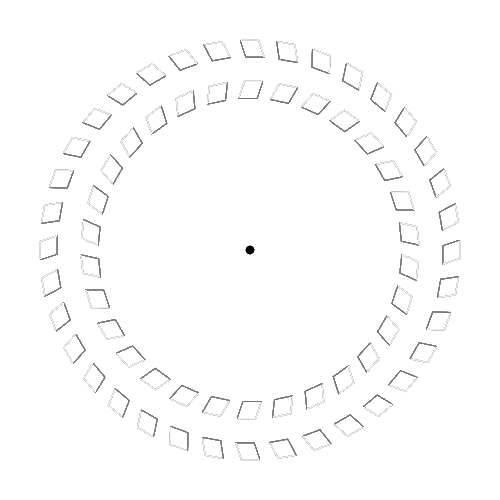
The cover image presents a visual illusion of motion. When you focus on the
central point and move the page toward or away from your eyes, the concentric
circles appear to rotate.
This reflects a central theme of this work: perception shapes what we think of as
“reality.” In this illusion, motion exists only in our minds. We perceive, we do
not directly know; our brains construct experience.
Introduction
“If I have seen further it is by standing on the shoulders of
Giants.”
As many of the topics discussed in this book are a mix of
established math and physics, proposed
dualistic interpretations of established ideas, and also
speculative ideas that I don’t yet know how to address,
I wanted a way to clearly distinguish these concepts. I’ve come up with
the following convention to highlight these classes of concepts to
indicate their level of mainstream acceptance.
In this book, established concept may be highlighted in green, and
represent mainstream physics or math concepts.
New ideas proposed by the author which have not been peer reviewed,
verified or tested, and should be looked at with scrutiny.
Proposed Concept
With the speed of light, c = 1: E2 = m02 + p2
Speculative Idea, that the author wonders about, but does not know
how to demonstrate, or ideas that need further treatment to prove or
disprove.
Speculative Concept
With the speed of light, c = 1: E2 = m02 + p2
Chapter 1
Blah blah blah
Example Content
In Rν the Planck
Length is the universal unit for measurement of distance, and is
defined approximately to be: $$\boxed{L_P=\sqrt{\hbar}=5.72928\times10^{-35}m=1
L}$$ Where 1 L, is 1
Planck Length of distance.
SI Conversion Factors
The following conversion factors can be used to convert observable
quantities of measure from the SI system of units to Rν to ~6 significant
digits.
Applying conversion factors from the table above, we can convert SI
values to Reduced Natural Units. For example, performing this analysis
on the the speed of light yields a unit-less number with a value of
1:
As a consistency check, we compute the Fine
Structure Constant using Reduced Natural Units which is a unit
less ratio that should be independent of our system of units.
The reader should be familiar with high school physics and chemistry
dimensional
analysis.
1 meter (m) = 100 centimeters (cm)
1 kilometer (km) = 1000 meters (m)
1 mile = 5280 feet (ftor′)
$1\ foot\ (ft\ or\ ') = 12\ inches\ (in\
or\ ")$
$1\ inch\ (") = 2.54\ centimeters\
(cm)$
How many kilometers are in 1 mile? $1\ mile
= 1\ mile \times \frac{5280\ ft}{mile} \times \frac{12\ in}{ft} \times
\frac{2.54\ cm}{in}\times \frac{1\ m}{100 cm} \times \frac{1\ km}{1000
m} = \frac{5280 \times 12 \times 2.54}{100 \times 1000}\ km =
\frac{160934.40}{100000}\ km = 1.6\ km$ Note that each unit in
the denominator cancels with one if the numerator until we are left with
only km.
Newton’s Law of Gravity
The force of gravity (Fg) between 2
masses, m1 and m2 separated by distance r is given by Newton’s
Law of Gravity:
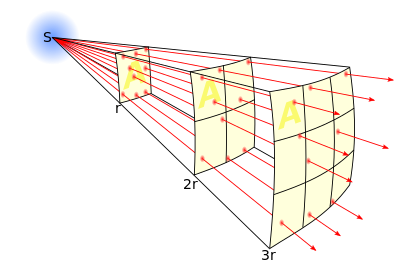
The strength of gravitational force follow the inverse square law
distributing gravitational flux over the surface area of a sphere (4πr2).
Inverse Square Law
Any source of a signal strength (S0) that radiates
isotropically in 3-dimensional space will distribute that signal
strength (S0) over
the surface area of a sphere (SA = 4πr)
of radius (r). Such that the
intensity (I) at distance
(r) is:
$$I(r) = \frac{S_0}{4 \pi
r^{2}}=\frac{S_0}{2 \tau r^{2}}$$
#### Rν Reduced
Gravitational Constant In this version of Newton’s Law of Gravity we
introduce a new constant G0, the reduced
gravitational constant to accommodate for the factor of 4π = 2τ which is has been
integrated in the SI version of the gravitational constant.
Analyzing the units: $$\frac{N \cdot
m^2}{kg^2} = \left( \frac{\left( kg \cdot \frac{m}{s^2} \right) \cdot
m^2}{kg^2} \right)=\frac{m^3}{s^2 kg}$$ Converting seconds to
meters with the SI speed of light as a conversion factor: $$\frac{m^3}{s^2
kg}\cdot\frac{1}{c^2}=\frac{m^3}{s^2
kg}\cdot\frac{s^2}{m^2}=\frac{m}{kg}$$
Thus where space and time are measured in units of meters, the
reduced gravitational constant, is:
Observation This implies that not only can space an time be measure
in units of meters, but so can mass.
Relativistic Energy
Momentum Relation
Einsteins Relativistic
Energy Momentum relationship shows a Pythagorean relation between
the total energy (E), rest
mass (m0) and
momentum (p) of a system.
E2 = (m0 ⋅ c2)2 + (p ⋅ c)2
Where space and time are both measure in units of meters, c=1.
E2 = (m0)2 + (p)2
From this we can see that Energy, Momentum and Mass have equivalent
units.
While we do not really know what energy, mass and momentum are we
know that they are fundamentally “made” out of the same stuff because
they have the same units.
Objects of mass at rest
For an object at rest with no momentum (p = 0) we see Einstein’s famous
equations:
E = m0 ⋅ c2
Or, with c = 1, this is
much simpler to understand. Energy = Mass
E = m0
##### Zero mass objects moving at the speed of light And for objects
with no mass, like photos, (m0 = 0):
E = pc
Or, with c = 1, this is
much simpler to understand. Energy = Momentum
E = p
Planck’s Constant
The Reduced
Planck constant , ħ, represents a conversion factor for relating the
frequency, ω (in 2π radians per second), of a photon
to the energy of that photon. This can easily be seen from the simple
but profound relationship:
Simplifying our units by converting time and mass to units of meters:
$$\boxed{\hbar=1.054571726 \times 10^{−34}
{kg}\cdot\frac{m^2}{s}\cdot\frac{G_0}{c}=3.282462\times10^{-69}m^2}$$
Which suggest that the Plank constant can be interpreted as an areas
for which the square root of is suspiciously close to the Plank
length:
and lP2 = ℏ
## Bekenstein’s Bound After having recently read Three Roads to
Quantum Gravity by Lee Smolin, I now suspect the meaning of this
areas is related to the Bekensteins
Law as applied to a surface areas surrounding a mass. Where the thermodynamic
entropy, S, is proportional to the the enclosed surface
area, A.
$S=\frac{1}{4}\cdot\frac{A}{G\hbar}$
$S=\frac{k c^{3} A}{4 G \hbar}$
$S \le \frac{2\pi k R E}{\hbar c} =
\frac{\tau R k E}{\hbar c}$
From our new values for G0and ℏ we can likely rewrite this:
$S=\frac{\pi\cdot A}{\hbar G_0}$
With the limiting case being at the Plank scale.
$S=\frac{\pi\cdot \sqrt{\hbar}}{\hbar
G_0}$
Planck Length
https://en.wikipedia.org/wiki/Planck_length
The concept of the Planck Length comes from exploring the limits of
Quantum Mechanics and General Relativity. The limits of General
Relativity can be seen a the event horizon of a black hole, described by
the Schwarzschild Radius. And the limits of Quantum Mechanics can be
found in the Compton Wavelength for a given quanta.
The Schwarzschild
Radius is defined as the distance at which light cannot escape from
the gravitational field of a mass (m):
Classic Derivation.
$r_S=\frac{2G m}{c^2}$
The reduced Compton
Wavelength represents a lower limit on the wavelength for quanta
that can interact with a quantum particle with mass (m):
Which is in precise agreement with the value we found in above. Thus
the Plank Length is:
$L_P=\sqrt{\hbar}=5.72928\times10^{-35}m$
When we measure distance, time, and mass in units of distance, c=1,
and the Plank Time, TP, is equal to
Plank Length, LP, which is
equal to the Plank Mass, MP:
https://en.wikipedia.org/wiki/Fine-structure_constant As a
consistency check, we compute the Fine Structure Constant using
Reduced Natural Units which is a unit less ratio that should be
independent of our system of units.
This check confirms that our system of Reduced Natural Units has
internally consistent values for c, ϵo, ℏ and e−. And also Go which was
used to computer prior values is also consistent.
Sage Code
Unit Analysis computations have been performed with Sage Math.
# Define constanceone = 1.n(digits=6)pi = pi.n(digits=6)tau = 2 * pit = tau# Define the unitsmeters = var('m')m = one*metersseconds = var('s')s = secondskilograms = var('kg')kg = kilogramsnewtons = kg * m / s^2N = newtonsjoules = N * mJ = joulesprint("pi =", pi)print("tau =", t)# Speed of light in meters/secondspeed_of_light = 299792458 * meters/secondssol = speed_of_lightc = solprint("si c =", c)rnu_c = c / cprint("R\u03BD c =", rnu_c)# Gravitational Constantgravitational_constant = 6.67384e-11 * N*(m^2/kg^2)G = gravitational_constantprint("si G =", G)rnu_G = 4*pi*G/c^2Go = rnu_Gprint("R\u03BD Go =", Go)# Planck's Constantreduced_plancks_constant = 1.054571726e-34 * J*sh_bar = reduced_plancks_constantprint("si \u210F =", h_bar)rnu_h_bar = h_bar * Go / cprint("R\u03BD "u"\u210F =", rnu_h_bar)# Planck Lengthrnu_h_bar_str = str(rnu_h_bar)numerical_part_str = rnu_h_bar_str.split('*')[0]numerical_part_str = numerical_part_str.strip('()')numerical_part = float(numerical_part_str)rnu_sqrt_h_bar = numerical_part^(1/2)# ^ Sage cannot process sqrt on units... Lame.lP = rnu_sqrt_h_bar * mprint("R\u03BD \u221A\u210F =", lP)
Output
pi    = 3.14159
tau   = 6.28319
si c  = 299792458*m/s
Rν c  = 1
si G  = (6.67384e-11)*m^3/(kg*s^2)
Rν Go = (9.33135e-27)*m/kg
si ℏ  = (1.05457e-34)*kg*m^2/s
Rν ℏ  = (3.28246e-69)*m^2
Rν √ℏ = (5.72928e-35)*m
si lP = (1.61620e-35)*sqrt(m^2)
Rν lP = (2.77455e-47)*sqrt(m^3/kg)
 ####
#### 